The bet: why a small homebuilder went AI-first
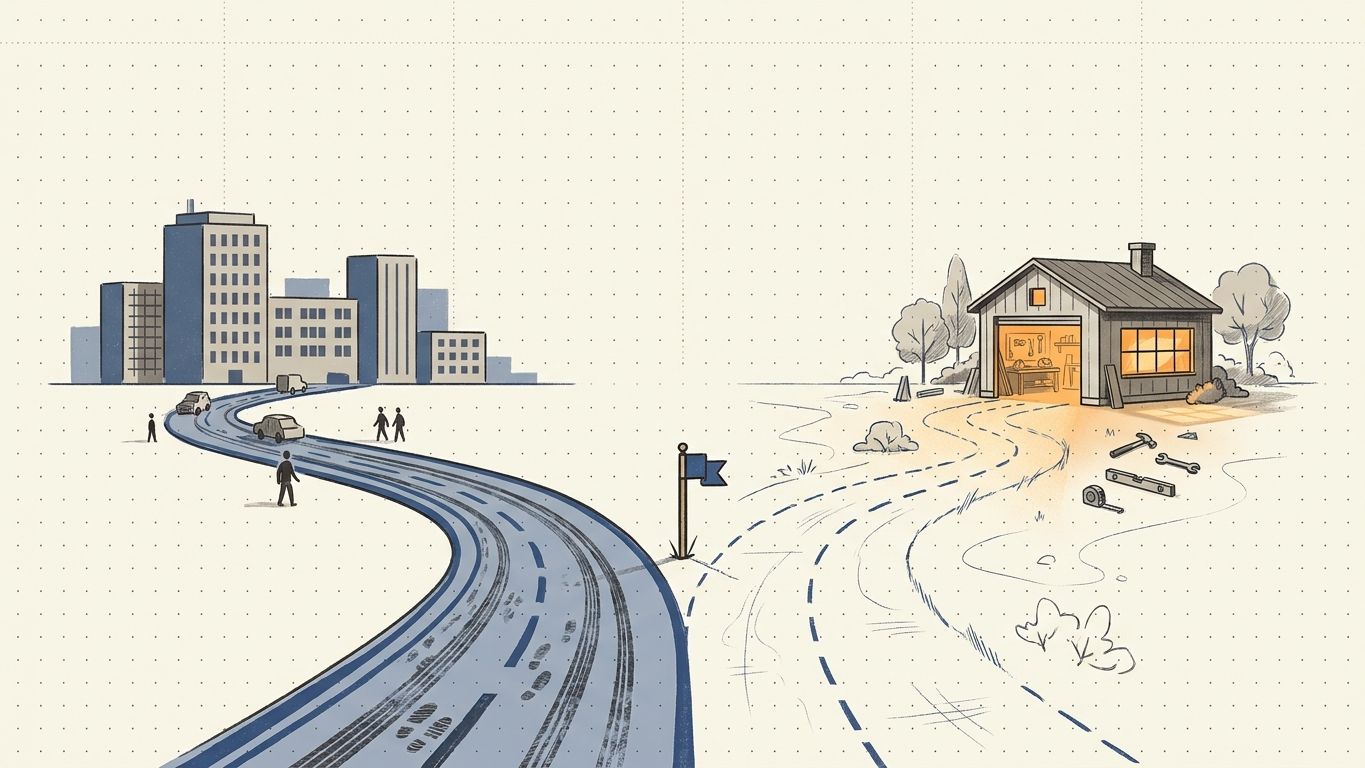
Before there was a system, there were 2,572 lines of notes spread across seven files. I counted. Project notes, lessons learned, half-finished plans, reminders about reminders. And not one of those 2,572 lines could answer the only question that actually matters at six in the morning: what should I do today?
That's the honest starting point. Not a vision. A mess — the same mess most small construction companies run on, except mine happened to be digital.
Some context for how we got to the fork in the road. I'd spent much of 2024 and early 2025 building RealDeal — an application that pulls in MLS listings, runs the numbers, and shows you what investment opportunities exist each day. One page. One purpose. It worked, and the discipline behind it was a lesson I'd already paid for once: my earlier software project, FluidCM, had sprawled into about twelve apps on a single platform, which is approximately eleven too many for one person to maintain, support, and market. RealDeal succeeded specifically because I gave it a single job and refused to let it grow legs.
So there I was: a small development company, a validated deal-finding tool, a capable partner running field operations, and a choice about what to build next.
Three paths
The back-office systems with the biggest impact on a young development company came down to three options.
Path one: build a deal pipeline. Done. RealDeal handled it. Check.
Path two: buy or build field efficiency tools. Software and systems to make our crews faster on the jobsite. This is what a conventional builder would choose. It's tangible, it's measurable, and it's what every construction consultant would recommend. Bring in a specialist, buy the software, train the crews.
Path three: build an AI decision-making system. Something that learns from our work, remembers our mistakes, and helps us think more clearly before we commit money.
I chose path three. Every sensible advisor on earth points at path two, and I understand why — you can photograph a faster framing crew. You cannot photograph a bad decision that didn't happen. But path three was the right bet for us, for three reasons that are all really one reason.
Why the weird one
The asymmetric bet. In real estate, the money is made when you buy. A field efficiency tool might get you a 5-to-10-percent improvement on executed work, and that's real money. But buy one property at the wrong price, with the wrong assumptions, in the wrong market, and you can blow months of that improvement out the window in a single signature. I wanted a system that could stress-test our thinking before we commit capital — not a spreadsheet with hardcoded assumptions, but something that adapts to how we actually evaluate deals and gets sharper over time. Avoiding one bad deal beats a year of faster framing.
The memory problem. Here's something nobody warns you about getting older in this industry: you start repeating mistakes you already made ten years ago, because you forgot you made them. I've watched it happen to me, and I've watched it happen across companies — the same errors, the same budget overruns, the same "we should have known better" conversations, cycling through the industry like expensive folklore. After reading Ray Dalio's Principles, I'd been looking for a way to codify our lessons — not in a binder that collects dust, but in a system with actual memory. Something that can say "you tried this in 2024, and here's what happened" right before I cheerfully walk into the same wall again.
The learning window. Our company is small right now. Manny runs the field, and I have time between deals to think about systems. That window will not stay open. Once we're running ten or fifteen active projects, nobody will have time to build foundational infrastructure — it'll be too late to start. And AI itself is moving fast enough that the only way I've found to understand what it can really do is to sit down with it every day and build something. There is no owner's manual for this technology. Everyone is figuring it out at the same time, which means a small builder in the Central Valley is, for once, not actually behind.
Underneath all three reasons is one economic idea I'll come back to throughout this book: not all hours are worth the same. Some of what I do is genuinely high-value — structuring a deal, designing a system. A lot of what filled my days was ten-dollar-an-hour work wearing a suit: filing, formatting, chasing, re-typing. The bet, at bottom, was that software could absorb the low-value hours so the high-value ones had room to exist.
The first months
So I installed Claude Code — an AI tool that runs on my own machine and can read files, write code, and do real work, not just chat — and started building. Not a demo. An operating system for how we run the business.
The early work was gloriously unglamorous. We stood up our accounting on an open-source ERP platform — a story with enough bruises that it gets its own chapter (2.7, Enterprise accounting for $5K). We built memory structures so the AI actually retains context from one session to the next instead of greeting me like a stranger every morning. We wrote down decision frameworks that encode the lessons we'd learned the hard way, in a form a machine can check us against.
And I learned the first big lesson of the whole project: the technology was not the hard part. The hard part was getting an AI system to behave consistently — to follow our rules without drifting off course — which turns out to be a much stiffer problem than anyone selling AI tools would like you to believe. Most of Part III of this book is the tuition we paid on exactly that.
The bet, stated plainly
Here it is in one sentence: build the back office out of software before hiring people into it, and treat every lesson learned as an asset the company keeps.
Was it obviously right at the time? No. Path two was the defensible choice, the one I could have explained at a lender lunch without anyone's eyebrows moving. What I can tell you from this side of it: the system that grew out of that mess of 2,572 lines now runs 21 scheduled jobs whether I show up or not, holds hundreds of accumulated memories about how we work, and operates on a hard $25-a-day budget I set for it. The rest of this book is the tour — including every place where the bet nearly went sideways.
But first we need to define terms, because "AI-first" has been abused half to death by people selling things.
The Field Notes newsletter
Get HPC in your inbox
Notes from a builder running a homebuilding company on AI — attainable housing, construction ops, and the systems behind them. No spam, unsubscribe anytime.