Chat → Cowork → Agent
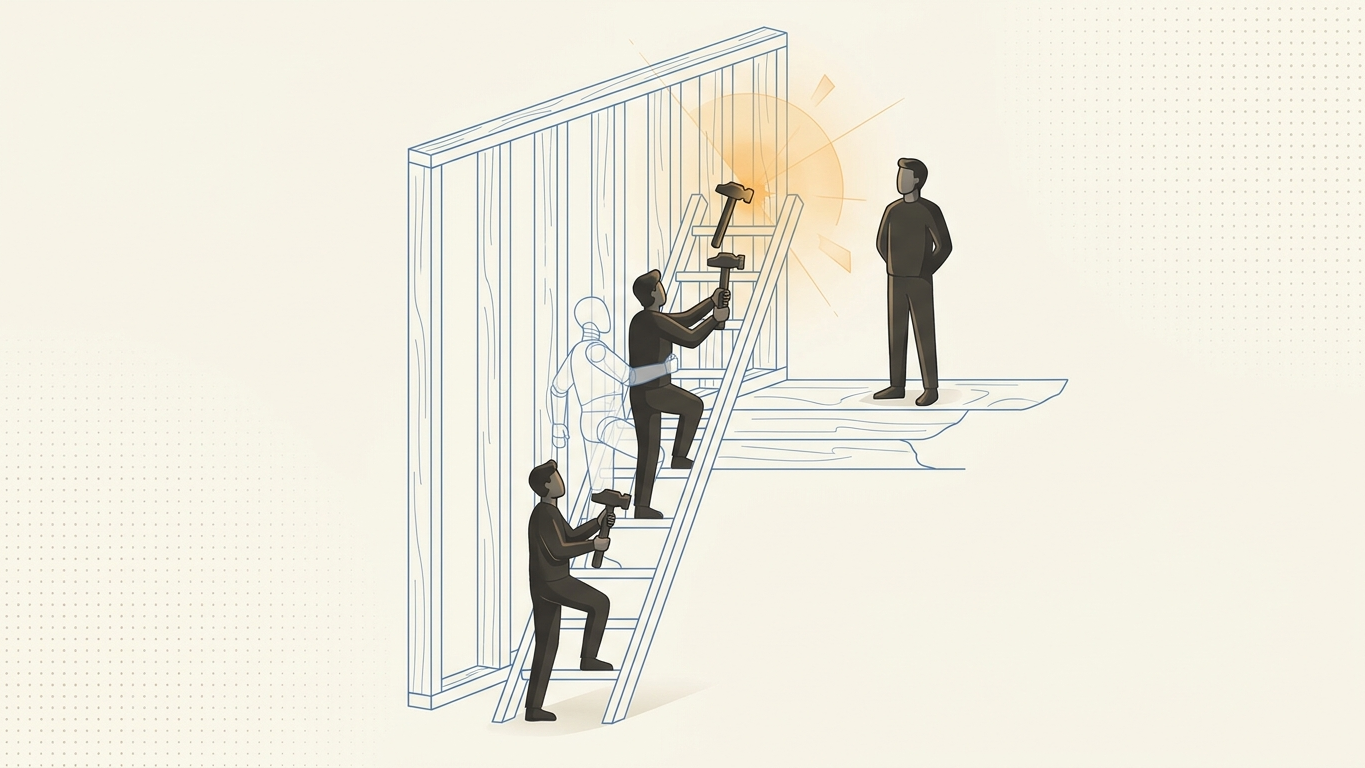
Thirty-five-plus scripts and a growing bench of agents into building this system, the most valuable thing I've learned about AI agents is when not to use one. That's an awkward confession from a guy whose Part II is essentially a tour of agents, but it's the honest one, and it's the difference between companies that get compounding value from AI and companies that get a demo, a bill, and a story about how AI "didn't work for us."
Everybody wants to skip to the robot. The demos all show the top rung — the autonomous agent doing a week of work overnight — because the top rung makes the best demo. But there's a ladder under that rung, most companies belong on the first step of it for longer than their pride prefers, and each rung has to be earned. Here's the ladder, and what graduates you.
The three rungs
Rung one: Chat. You ask, it answers, and every action is still taken by a human. Drafting a letter, summarizing a contract, explaining a spec, answering questions against your own documents and procedures. Blast radius: zero. The AI never touches your systems; it just makes the human faster.
Chat is wildly underrated precisely because it's the least impressive rung. A team that habitually asks an AI before asking a coworker — and gets correct answers because the underlying documents are clean (Chapter 1.1) and live in known places (Chapter 1.2) — is already banking most of AI's easy money. This is Phase 1 of the build order in Part IV, and it's low-risk with immediate payback.
Rung two: Cowork. The AI now works inside your systems — reading your files, drafting journal entries, analyzing your ledger, writing code — but with a human watching every move and approving every change. Think apprentice, not contractor: real work, real tools, and a journeyman signing off on all of it. This is where I've spent most of my last year, and where the AI does its most valuable learning, because every approval and every correction is a lesson you can write down.
Rung three: Agent. The AI acts on its own — on a schedule, or when something triggers it — with authority to act and a budget to spend, reporting after the fact. The morning brief that assembles itself, the meeting prep that appears the night before, the 21 scheduled jobs that run whether I show up or not. This is the only rung that works while you sleep. It is also the only rung that can be wrong while you sleep, which is why everything in Chapter 1.4 — Governance before capability gets installed before anything is allowed to live here.
The fork nobody mentions: script or agent?
Right between rungs two and three sits a fork that almost no AI pitch acknowledges, and it saves so much money it deserves its own subhead: most of what people call "agent work" should actually be a script.
A script is a fixed list of instructions a computer follows exactly, every time — deterministic, instant, cheap, and debuggable. An agent is an AI making judgment calls about what to do next — flexible, slower, costlier, and capable of going quietly in the wrong direction. The sorting rule that finally ended my own decision paralysis: scripts are for transformation, agents are for exploration.
Syncing tasks between two systems? Known inputs, enumerable logic, structured output — script. It runs every fifteen minutes and never has an opinion. But "why is the profit-and-loss wrong on this property?" — unknown starting point, multiple hypotheses, an answer that emerges by following a trail through the ledger — that's exploration. No script can do it, because it requires curiosity.
I got this wrong in every direction available before the pattern stuck. I assumed agents were smarter, so use them everywhere — but for deterministic problems the script is smarter, because it's faster, cheaper, and incapable of creativity. I assumed I needed agents for edge cases — but if you can list the edge cases, you can code them; agents are for when you genuinely can't enumerate what you'll find. And I assumed scripts couldn't be intelligent — but a script that makes one AI call for one judgment step (classify this transaction, summarize this log) is still a script, with a script's reliability and a penny's worth of thinking inside.
The best workflows layer them: a script gathers the evidence, an agent makes meaning of it, a script files the result. Mechanical, semantic, mechanical. Maximum leverage isn't maximum AI — it's intelligence exactly where judgment is needed and dumb reliability everywhere else.
What graduates you to the next rung
The ladder isn't a personality test; the promotions have criteria.
Chat to Cowork takes two things. First, foundations: clean data and named sources of truth, because a coworking AI writes into your systems, and Chapter 1.1 covered what happens when machines write into a mess. Second, habit: if your team doesn't already reach for chat daily, coworking will be a novelty, not a capability. The tool follows the culture, never the other way around.
Cowork to Agent has three tests, and I'd hold every candidate task to all three:
The pattern is proven. You've done this task together at rung two enough times that the procedure is written down and boring. A useful side effect of writing it down: if the procedure turns out to be fully deterministic, you don't need an agent at all — you need a script, and congratulations on the discount.
The governance is installed. Ranked rules, spending caps, approval gates on anything irreversible — Chapter 1.4, in its entirety, is a prerequisite, not a suggestion.
The output has a consumer and the failure is survivable. Somebody — or some system — demonstrably reads what the agent produces, and the worst plausible mistake is one you can absorb. An unread output is a broken feature that hasn't been diagnosed yet; Part III has the scar tissue on that one.
One more graduation requirement, learned the embarrassing way: as you climb, your instructions become infrastructure, and they have to be scoped like one. We once discovered our root-level AI configuration — the instructions every session reads first — was hard-coded with the specifics of a single project, our construction platform. The result was an AI with a mild identity crisis that tried to apply construction-app logic to a financial database. The fix was to organize instructions the way you organize a set of plans: general notes up front, sheet-specific details on the sheet, and never the reverse. At rung two, a misscoped instruction is an annoyance you correct in the moment. At rung three, it runs unsupervised at 2 a.m.
Climb in order. Stand on each rung until it's boredom pushing you upward, not ambition. The companies that skip rungs don't skip the lessons — they just pay for them at agent prices.
That's the foundation, all five chapters of it. Now I'll show you what we built on top.
The Field Notes newsletter
Get HPC in your inbox
Notes from a builder running a homebuilding company on AI — attainable housing, construction ops, and the systems behind them. No spam, unsubscribe anytime.